AI-Generated Product Page Copy: The Penalty is Not the Real Risk
By Ava Nicewonder, SEO Expert
If you have heard about a new Google update and wondered what it means for your store, you are not alone. Here is what happened and what it means for your product pages.
On September 24, 2026, Google started rolling out its September spam update. It is the fourth spam update of the year after March, June, and August. The March update finished in under a day. For this one, Google said the rollout may take up to two weeks.
The next day, Search Engine Journal covered a Google research paper on a new system built to catch AI-generated spam. That combination sent a lot of founders to their product pages with one question: did I just get caught for letting ChatGPT write my descriptions?
The short answer is probably not. But the reason may surprise you, and there is still a real opportunity sitting in a lot of those pages.
What Actually Happened
Two things happened in the same week, and it helps to keep them separate.
The first is the spam update itself. It applies globally and to all languages. As of September 30, 2026, Google had not marked the rollout complete, and its two-week window runs through about October 8. It also has not named a specific policy it is going after.
The second is a research paper. Google published details of a system called the Scaled Abuse Forensics Examiner, or SAFE. According to Roger Montti's reporting in Search Engine Journal, it looks at content, publishing behavior, and shared infrastructure across the accounts producing that content. The paper says it has already been deployed.
There is an important detail that many headlines left out. The paper is only three pages long, does not share its test results, and much of its language leans toward synthetic video. Montti wrote that SAFE may be part of the spam update. That is a reasonable read, but it is not a confirmation from Google.
So SAFE gives us direction rather than detail. Google is investing in catching AI content that exists only to game results, and it is looking at patterns across whole networks rather than one page at a time.
Google Does Not Care That You Used AI
I hear two very different takes on this. Some founders assume any AI copy is a ticking time bomb, and others assume anything goes. The truth sits in the middle.
Google's own guidance says generative AI can be useful for researching a topic and adding structure to original content. The line it draws is using AI to generate many pages without adding value for users, which may violate its spam policy on scaled content abuse. The Search Quality Rater Guidelines back this up with a section on main content created with little to no effort, originality, or added value.
Nick LeRoy put it plainly in Search Engine Land:
Google doesn't care that you used AI. It cares what you did with it.
I think of AI as a sous chef. A good one preps faster than you ever could, and nobody complains that you had help in the kitchen. But a restaurant that sends plates out without the chef tasting them will eventually serve something it should not have, and customers never blame the sous chef. They blame the restaurant.
Why Most Stores Your Size Are Not the Target
Scaled content abuse is about volume and intent. Think thousands of near-identical location pages, a blog publishing dozens of AI articles a week on topics the brand has no connection to, or hundreds of product pages where the only thing that changes is the color name.
A store with 35 SKUs that used ChatGPT to draft its descriptions is not what that policy was written for. Google does not publish its thresholds, so I cannot promise anything, but if every page on your site sells something real, a penalty is not your most likely risk.
The exception is anything published in bulk to chase traffic. If you or a past agency pushed out a large batch of AI blog posts in a short window, look at those first.
The Real Cost is Quieter Than a Penalty
What I see far more often than penalties is product pages that are technically fine but not doing much to help the sale.
Unedited AI copy has a sound. Elevate your everyday. Crafted with care. The perfect blend of style and comfort. None of it is wrong, but it is true of every product in your category, which means it says nothing about yours.
That costs you in three places.
1. Conversion
A skeptical shopper wants fit notes, materials, how the product holds up, and what happens if it does not work for them. Generic copy answers none of that, so they go back to the search results to find a page that does.
2. Organic Rankings
Google's systems are built to reward pages that help people. When your description reads the same as three competitors who used the same tool, Google has no reason to prefer yours. That leaves overall site strength as the deciding factor, which is a tough contest for a growing brand.
3. AI Search Visibility
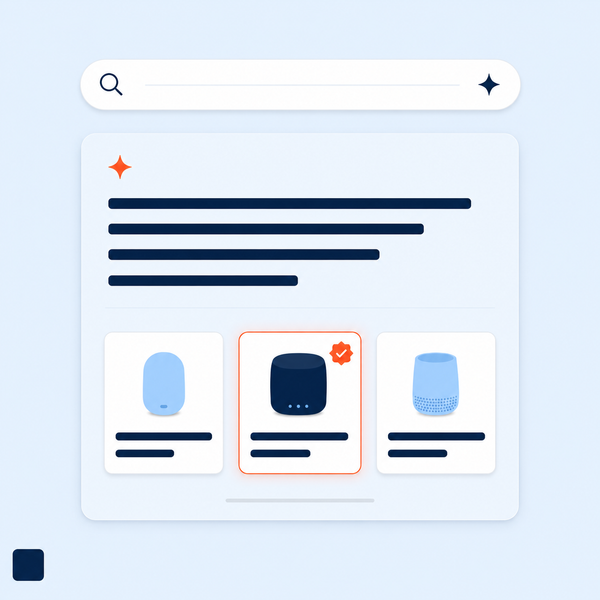
AI answers tend to pull from pages with something specific to lift, like a clear spec, a direct answer, or a real number. A paragraph of adjectives gives them very little to cite. If some of your product pages rank well but rarely show up in AI answers, generic copy is one of the first things I would look at.
What AI Can Handle and What It Cannot
The fix is not to stop using AI. It is to be clear about which jobs it is good at and which ones still need human influence.

That last row matters more than most founders realize. Google's guidance specifically calls out metadata like title tags, meta descriptions, structured data, and image alt text, and asks that you focus on accuracy and quality there too, especially when it is generated automatically.
The Swap Test
This is the fastest way I know to find weak product copy, and it takes about five minutes a page.
Open a product description and mentally remove your brand name and product name. Then ask one question: could a competitor paste this onto their own product page without changing a word?
If the answer is yes, the page is interchangeable. It is a rental car. It gets the shopper from point A to point B, but nothing about it is yours, and nobody remembers it after they hand back the keys.
A page that passes usually includes at least three things AI could not have known on its own, such as a question from your support inbox, a detail about how the product is made, a use case customers keep mentioning in reviews, a number from your own testing, or honest guidance on who the product is not for.
One Thing to Check If You Sell Through Google Shopping
If you use AI to write the product titles or descriptions you send to Google Merchant Center, Google's guidance says that AI-generated product data must be specified separately and labeled as AI-generated. AI-generated product images also need specific metadata that identifies them as AI-generated.
This is easy to miss because it lives in Merchant Center policy, not your Shopify admin. Checking takes minutes, which beats finding out through disapproved products in the middle of Q4.
How This Might Be Addressed
The answer is not to stop using AI. It is to add the step most brands skip. For a store your size, a sustainable process comes down to three habits.
A Human Review Gate on Every AI Draft
It helps to have a person check every AI draft against the actual product before it goes live. That review can be five questions. Is every claim true? Is there at least one detail only your brand could know? Does it answer the questions customers actually ask? Does it sound like your brand? Would you put your name on it?
Swap Tests Built Into Content Reviews
Make the swap test a standing part of how you review product and collection pages. It gives a clear pass or fail result, which is much easier to prioritize than a vague sense that the copy could be better.
Update Tracking in Your Reporting
Note every confirmed Google update in your reporting and wait for the rollout to finish before reading the impact. That one habit prevents most rewrites driven by panic rather than data.
Three Things to Do This Month
1. Mark the Rollout in Search Console and Wait
In Google Search Console, open the Performance report and note September 24, 2026 as the start of the update. Check the Google Search Status Dashboard to see when Google marks the rollout complete. Once it does, use the Compare tab in the Date filter to compare the two weeks after completion against the two weeks before September 24. Add a Page filter for URLs containing /products/ to isolate your Shopify product pages. Then open Security and Manual Actions, then Manual actions, to confirm nothing has been flagged.
Expect this to take about 30 minutes. Early Q4 traffic tends to shift on its own, so comparing against the same period last year is helpful if you have the data. I would also wait for the full picture before rewriting anything based on a few days of movement.
2. Run the Swap Test on Your Top 10 Product Pages
In your Shopify admin, go to Analytics, then Reports, and open the report that breaks down sales by product to find your 10 best sellers. Run the swap test on each one and mark it pass or fail in a simple sheet. Start with revenue rather than traffic, because a weak page that already sells has the most to gain. Expect about an hour.
3. Add a Human Review Step Before Anything Goes Live
For every page that failed, rewrite it with AI as the drafting tool and a person as the editor. Give the AI real inputs, including your spec sheet, your most common support questions, and a handful of actual reviews. Then have someone who knows the product check every claim and add at least three details AI could not have known. If you sell through Google Shopping, confirm in Google Merchant Center that any AI-generated titles and descriptions are labeled.
Expect 20 to 30 minutes per product once the process is set, which works out to roughly four to five hours for your top 10. After that, the review step adds about 10 minutes to every new product launch.
FAQ: What DTC Founders Are Asking About This
Does Google Penalize AI-Written Content?
Not for being AI-written. Google's guidance says AI can help with research and structure. What it targets is content produced at scale with little effort or originality, regardless of how it was made.
Is the September Spam Update About AI Content?
Google has not said. It has not named a target for this update. Search Engine Journal reported that the new SAFE system may be part of it, but Google has not confirmed that connection.
My Traffic Dropped After September 24. Was It the Update?
It could be, but it is too early to say for sure. I would wait for the rollout to finish, check Search Console for a manual action, and compare against the same period last year to rule out seasonality.
Should I Delete My AI-Written Pages?
Not reflexively. A product page that sells should be improved, not deleted. Pages that exist only to chase traffic and serve no real customer purpose are the ones to consolidate or remove.
If I Fix My Pages, How Fast Will I Recover?
Slowly. Google's documentation says it can take months for its automated systems to learn that a site complies with its spam policies. That is one more reason to build the review step in now rather than after a drop.
What Does EcomIQ Actually Do in This Area?
Measurement setup, extraction audits, and content structure are core to what we coach through. See how our coaching works. If you would like a deeper look at measuring AI search visibility, our earlier piece on the Search Console generative AI report is a helpful companion to this one.
The Bottom Line
AI did not create the thin product page problem. It just made thin pages faster and cheaper to produce, and Google is clearly investing in catching the ones built to game results.
For a store your size, the risk is less about a penalty and more about sounding like everyone else at the exact moment a skeptical shopper, or an AI answer, is deciding who to trust.
Use AI to draft and keep a human as the final editor. The brands that treat AI as the sous chef rather than the chef are the ones whose pages will still be worth reading, ranking, and quoting a year from now.
Here is how EcomIQ works if you want to talk through what this looks like for your brand specifically.