GEO for Shopify: Get Recommended by AI Search
Your buyers stopped searching and started asking, and the AI answers with a shortlist. Here's how to make sure your products are on it.
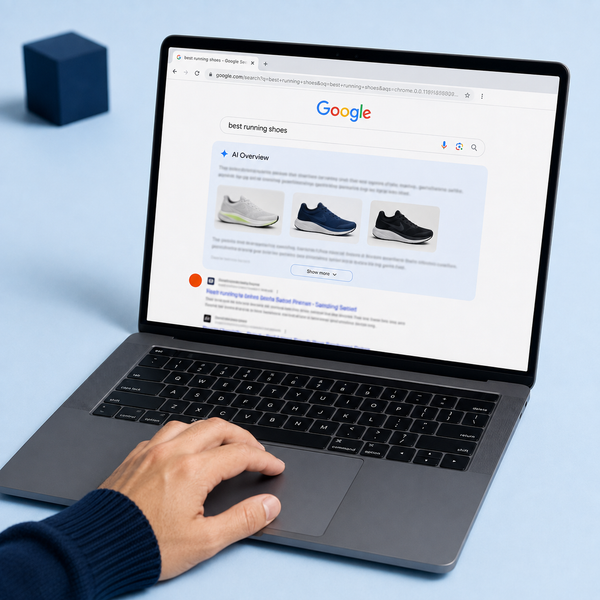
Someone shopping for what you sell doesn't type two words into Google anymore. They type a sentence. "Best magnesium for sleep that isn't chalky." And Google, or ChatGPT, or Perplexity writes them back a shortlist of products before they ever see a blue link.
Here's the number that should get your attention. Google's AI answers now show up on roughly 14% of shopping queries, and that figure jumped more than fivefold in four months. AI Mode queries run about three times longer than the old keyword searches. The buyer has stopped searching and started asking. And the AI is answering with a shortlist.
Your job used to be ranking on that page. Now it's making the shortlist inside the answer. That's a different game, and frankly most brands haven't clocked it yet.
The discipline has a name now: generative engine optimization, or GEO. Some people call it AEO, answer engine optimization. Same thing. It's the work of getting your product into the answer the AI writes, not just the page it used to link to. And unlike a lot of what gets badged as "AI strategy," there's actual research on what works. Let me walk you through it.
What the research actually says
The first proper study on this came out of Princeton, IIT Delhi, Georgia Tech and the Allen Institute for AI. They tested nine different ways of changing content across 10,000 queries and measured which ones got cited more by the AI. Not opinions. Measured results.
Three things moved the needle most: citing sources, adding direct quotes, and adding statistics. Each one lifted citation rates by 30 to 40%. Adding hard numbers was the single strongest move, around 41%.
Read that back. The AI doesn't reward the cleverest copy. It rewards the most verifiable copy. Specific, sourced, numbered. The vague stuff gets collapsed into a generic answer, and your brand disappears into it.
And look, that should be good news for an operator. You've got real numbers. You know your repeat purchase rate, your reorder window, your actual ingredient sourcing. Most of your competitors are still writing "premium quality, ethically sourced." You can out-specific them, full stop.
Where the AI actually pulls your products from
Here's where it matters for a physical-product brand, because most GEO advice is written for SaaS blogs and misses half of it. When an AI builds a shopping shortlist, it's pulling from a few places at once. Walk them in order.
-
Your product feed. This is the big one, and the one brands neglect. Google's Shopping Graph holds more than 60 billion listings, and its shopping AI reads your feed to decide what to surface. A feed with just a name and a price gives it nothing to work with. A feed with material, fit, use case, GTIN and a proper description gives it something to match against a long, specific query. When a buyer asks for "merino base layer for skiing that isn't itchy," the brand whose feed actually says merino, base layer, non-itch is the one that wins. Fill every field. Every one.
-
Your product page. Structured data does the heavy lifting here. One analysis found 65% of pages cited by Google's AI Mode, and 71% of pages cited by ChatGPT, had structured data on them. If your product pages aren't marked up with Product schema, including reviews and price, the AI struggles to read you cleanly. Worth knowing: Google retired FAQ and How-To schema in early 2026, so don't pour time into those. Product, review and organisation markup is where it counts.
-
Third-party signals. This is the one founders hate hearing. The AI doesn't just take your word about you. Perplexity pulls close to half its citations from Reddit. Google's AI Overviews lean on the organic top 10 and on review sites. ChatGPT runs on Bing's index. So the chatter about your brand on Reddit, the reviews on third-party sites, the "best X for Y" roundups, they all feed the answer. You can't fake that. But you can earn it, and you can make sure your best reviews are actually visible and structured.
The work, in order
Right. Enough context. Here's the job, ordered by what will move things fastest.
-
Fix the feed first. Highest-leverage thing on the list, and most brands have a half-empty one. Audit every field. Materials, dimensions, use case, GTIN, and a real description written for a human asking a real question. This is a same-week job, and it feeds both your paid Shopping and the AI shortlist at the same time.
-
Rewrite product and buying-guide content answer-first. The research is clear that AI engines extract a clean, self-contained answer from the top of a section. Put the answer in the first 40 to 60 words, then explain underneath. Use the real questions buyers ask as your headings. "Is this good for sensitive skin?" beats "Product Benefits" every time.
-
Load it with specifics. A number or a named fact every couple of hundred words. Your reorder rate. The actual fabric weight. How it stacks up against the obvious alternative, by the numbers. Remember the study: statistics were the single biggest lever, so this is not a nice-to-have.
-
Get the structured data on. Product schema with reviews and price on every product page. If you're on Shopify, your theme or an app handles most of this, but check it's actually firing. Don't assume it is.
-
Earn the third-party mentions. Get into the roundups. Make your reviews easy to find. If there's a Reddit thread where people are already asking what you sell, a genuine, useful presence there is worth more than another blog post on your own site.
One honest caveat
I'll be straight with you. This moves fast, and nobody selling you "guaranteed AI rankings" actually has them. What we do know holds up: fresh content gets cited far more, roughly three times more likely if it's been published or genuinely updated in the last three months. Note the word genuinely. Changing the date on a page does nothing. Adding a new stat, a new comparison, a new answer, that resets the signal. So this isn't set-and-forget. It's a quarterly habit.
At the end of the day, GEO isn't a new trick. It's the same thing good operators have always done. Tell the truth specifically, with numbers, where buyers are actually looking. The buyers just moved. So move with them.
We test this stuff every week, on real brands, with real money. If you want the plays that are working right now, before they're written up anywhere else, get on our mailing list. You'll get the tactics, the numbers behind them, and the ones we've quietly killed because they stopped pulling. First look, every time.