Shopify Made Your Store Discoverable on Every Major AI Platform
By Ava, Lead SEO at Pacific IQ
Everyone keeps calling this the ChatGPT update. I get why. ChatGPT is the headline. But that framing is actually underselling what Shopify quietly did here.
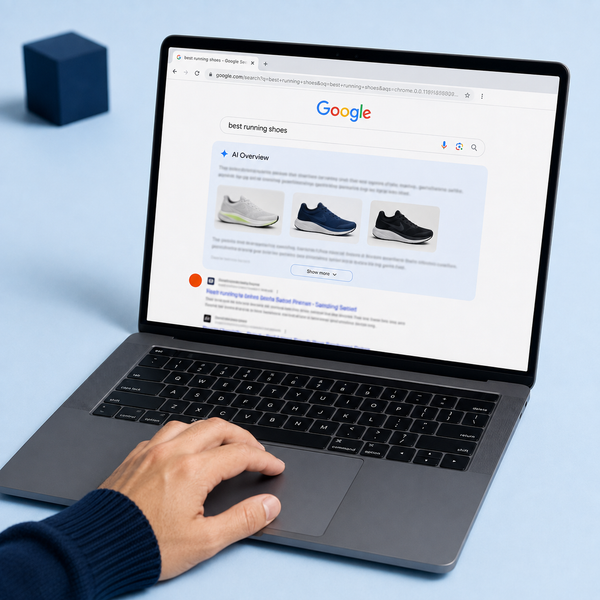
Shopify Agentic Storefronts is not a ChatGPT integration. It is your store becoming discoverable across ChatGPT, Microsoft Copilot, Google AI Mode, and the Gemini app, simultaneously, through one setup in your admin, with no extra fees from Shopify. Four platforms. All of it on by default since late March.
I have been across this since the December announcement and testing properly since rollout. Most of what is being written about it right now is either news recap or advice so generic it is basically useless. So here is the operator version.
What Is Actually Happening
The short version: Shopify built an infrastructure layer called Agentic Storefronts that feeds your product data, titles, descriptions, pricing, inventory, and images into AI platforms. When someone asks a shopping question, your products can now appear in the answer.
ChatGPT is live for all eligible stores right now. Microsoft Copilot has embedded checkout active. Google AI Mode and Gemini are in early access and rolling out. All four are managed from the same place in your Shopify admin and pull from the same Shopify Catalog data in real time.
How the purchase works: someone finds your product in a ChatGPT or Copilot conversation, clicks through, and buys on your own checkout. Your store. Your branding. Your customer. You keep the relationship. Shopify charges no additional fees. Every order shows up in your admin with channel attribution so you know exactly where it came from.
And the numbers Shopify is putting out are not small:

That is happening right now, while most brands have not made a single change to how their products are set up.
This Is Bigger Than Just ChatGPT
I want to be direct about something I flagged internally when this first dropped: the four-platform angle is being dramatically undersold.

All four are managed from the Shopify Admin. That is four new discovery channels simultaneously, with zero setup required. The operators treating this as a single-channel story are going to be caught flat-footed when Copilot and Gemini volumes catch up to ChatGPT.
What Almost Everyone Is Getting Wrong
I have read probably a dozen takes on this in the last few weeks and most of them land on the same advice: update your product descriptions. Which is correct, but it is so vague it might as well not be said.
Here is the actual insight. Paid media rewards budget. You outspend, you get visibility. Simple. AI discovery does not work like that at all. There is no bid. There is no budget lever. These platforms are doing something fundamentally different: they are trying to match a specific customer intent to specific product data. If your description is vague, there is nothing to match against. You are invisible, not because you spent too little, but because you gave the algorithm nothing to work with.
ChatGPT, Copilot, Google AI Mode, Gemini, they are all doing the same thing. Write your description to answer a real question and you have a shot on all four simultaneously. Write something generic and you disappear on all four simultaneously.
The Description Difference
The rewrite is not a copywriting exercise. It is a data exercise. Ask yourself: what exact question is my customer typing? Then write the description to answer it. Ingredient, format, benefit, who it is for, what it is not. That is the brief. If you want more on this, we have gone deep on your product pages are doing two jobs now.
One technical thing worth flagging: Shopify Catalog pulls the first 6,000 characters of your product description. Front-load everything that matters. Do not bury your best signals at the bottom.

The Feed Health Nobody Is Talking About
Before you touch a single description, I want you to spend 20 minutes in Google Merchant Center. I am serious about this.
Missing GTINs are the most common reason products fail to index in the feeds that power AI shopping. And any product with an active Merchant Center disapproval is invisible, not just on Google Shopping, but on Google AI Mode and Gemini as well. Same underlying feed infrastructure. A disapproval on one knocks you off both.
I have been emphasising this point internally because it is the piece most operators completely skip: feed health is now a direct AI visibility play. Better descriptions on top of a broken feed will still underperform. Fix the foundation first.

And frankly, if your Merchant Center is clean and your product data is solid, you are already ahead of most of the brands in your category. The opportunity is bigger for you than it is for brands with messy feeds. Fix the foundation first. Disapprovals cleared, GTINs in order, then go after descriptions. We have covered what feed health means for SEO in detail if you want to go deeper.
The Testing Framework We Are Running
I am not a fan of launching into a new channel and assuming it is working. You need evidence. Here is the framework we are running right now and that I would give to any operator starting this today.
Step 1: Start With Your Strongest SKUs
Pick your top 10 to 15 products with the best reviews, the clearest and most specific use cases, and buyers who arrive already knowing what they want. These are your best candidates for early AI discovery wins. Rewrite those descriptions first. Specific ingredients, formats, benefits, trust signals, use-case language. Everything important in the first 6,000 characters. If you are not sure where to start, read how we audit Shopify product data before you touch anything.
Step 2: Log Every Change Date
Sounds obvious. People skip it. You cannot attribute anything to these changes without a clear before-and-after line. Shared doc, Notion, spreadsheet, it does not matter. Just record the date.
Step 3: Run Consistent Test Prompts
Run the same commercial-intent prompts across ChatGPT, Copilot, and Google AI Mode every two to three days for four weeks. Use the language your actual customer would use. Not 'protein powder,' but 'best protein powder for women that does not cause bloating.' Note whether your product appears, where it sits against competitors, and whether the AI's description matches your copy. If it does not, your description is not landing.
Step 4: Set Up Attribution Before It Gets Noisy
This is one I have been pushing our clients on immediately. Create GA4 segments for chat.openai.com, bing.com for Copilot, and AI Mode referrals. Your Shopify admin already shows ChatGPT referral attribution on Agentic Storefront orders. Treat each platform as its own channel from day one. Do not let any of them disappear into direct traffic. If you want the full setup guide, we have written up tracking channels that actually move the needle.
Step 5: Track AI Session Conversion Rates
This is the data point nobody has good numbers on yet, and I think it is the most interesting one. My hypothesis is that AI-referred sessions convert at a higher rate than paid social. The intent is more specific, the discovery is more personalised, the person has already described what they want in detail before they even see your product. That is a very different buyer to someone who saw an ad while scrolling. We are building this data now. Start building yours so you have something real to compare in 60 days.
On Opting Out: More Complex Than You Think
A few clients have asked me about opting out, so I want to address this clearly: there is no single 'turn off Agentic Storefronts' button. What actually exists is multiple layers of control, each with a different effect on reach, SEO, and cross-channel visibility.

For clients with vendor agreements or strict brand control requirements, I recommend auditing each layer separately before making any changes. The opt-out decision is not binary, and the downstream SEO consequences of the wrong choice are real.
For most operators, opting out is the wrong call. The channel is free, the traffic is qualified, and the early data is moving in the right direction. The question is not whether to be in it. It is how to show up well.
Where I Think This Goes
I will be straight: we are early. AI discovery is not replacing paid social this year. The volumes are not there yet. But a 7x increase in traffic and 11x increase in orders since January is not noise, and the operators who get their foundations right now are going to have a structural advantage in 12 to 18 months that is going to be genuinely hard for latecomers to close.
I keep coming back to organic search in 2013. Most brands were not taking it seriously. The ones that built good content and solid site structure back then compounded that into real authority over years. AI discovery feels like that moment right now. Early, a bit messy, not yet crowded, clear inputs that you can actually control.
And here is the thing that I think is genuinely different about this channel: for the first time in DTC, your biggest marketing lever is not your ad creative, not your targeting, not your budget. It is the quality of the words on your product page. Most operators are not thinking about product pages as a discovery asset yet. The ones who start thinking about it that way now are going to be in a very different position when this matures. That is also the premise behind our thinking on reducing your dependence on paid as a long-term growth strategy.
Worth getting on it. Not in six months. Now.
The Short Version If You Are Time-Poor
- Go to Google Merchant Center. Fix any disapprovals. Sort out missing GTINs. Do this before anything else.
- Pick your top 10 to 15 SKUs and rewrite the descriptions to answer a specific customer question. Front-load the first 6,000 characters.
- Log the date you make each change. Run the same prompts across ChatGPT, Copilot, and Google AI Mode every few days. Watch what surfaces and how it is described.
- Set up GA4 segments for chat.openai.com, bing.com, and AI Mode. Track it as its own channel from the start.
- Do not opt out. Free channel, qualified traffic, early mover advantage. Get your data in order and get moving.
Want operator-led insights delivered before anyone else? Subscribe to our mailing list and get all our articles, strategies, and real numbers straight to your inbox, before they are published anywhere else. No fluff, just what is working right now for brands in the trenches.