Profit vs Cash Calculator
You're profitable on paper. So why is cash always tight?

It's Sunday night. You're checking Shopify. Revenue's up. Conversion's up. AOV's up. By every metric on the dashboard, the business is winning.
Then you check the bank account. And you do the math on next month's PO. And you realise, again, that you can't actually afford the inventory order you need to keep growing.
Profitable on paper. Tight on cash. Same business, two different stories. If you're nodding right now, you're not alone, and it's not a budget problem.
Here's what's going on, and it's worth understanding because once you see it you can't unsee it.
The number on your P&L isn't the number in your bank account
Your P&L tells you whether you made money. Your bank account tells you whether you have money. Those are not the same thing, and the gap between them is almost always sitting in customer acquisition.
Let's run the numbers. Say your CAC is $62. Your AOV on a first order is $80, and your contribution margin after COGS, fulfillment, processing, returns, all that, is 35%. So you make about $28 in margin on the first order.
You're underwater on every new customer by $34 ($62 in, $28 back) until they buy again.
Now, of every 100 new customers, maybe 22 buy again within 60 days. The other 78 take longer. Some never come back at all. The ones who do come back, take 90, 120, 180 days to bring you back to even and then some.
Multiply that across every customer you acquired this month. And last month. And the month before. At 800 new customers a month and a $62 CAC, you've got somewhere around $300k tied up in unrecouped acquisition spend at any given moment.
That's $300k you can't use for inventory. Can't use for hiring. Can't use to buy a new piece of equipment or fund a campaign. It's just sitting there, in customers, waiting to come back.
That's why cash feels tight even when the P&L says you're winning.
Why does it feel worse the faster you grow?
This is the part that catches founders out.
You'd think growing faster would solve cash flow. More revenue, more cash, right?
It's actually the opposite for most DTC brands in the messy middle. The faster you grow new customer acquisition, the more cash you've got tied up in unrecouped CAC at any moment. Doubling your acquisition doubles the gap, even if margins are great.
This is why brands at $1M, $2M, $5M raise rounds. Not because they're broken. Because the cash gap widens before it narrows, and you need somebody to fund the difference until repeat customers catch up.
If you're not raising, you've got three levers and that's it.
The three levers (and which one is fastest)
There are only three things that move the cash gap.
One: lower your CAC. Half your CAC, half your tied-up cash. This is usually the fastest lever to pull because you can do it without changing anything about your product or operations. Better creative, better targeting, better tracking. Most accounts have 15-30% in obvious waste once you actually look.
Two: lift your contribution margin. Get more dollars back per first order. AOV up, COGS down, returns down, processing fees down. This takes longer but compounds.
Three: lift your repeat rate. This is the one everybody talks about, "retention is the new acquisition," all that. It's true. A 10-point lift in 60-day repeat usually frees up tens of thousands in tied-up cash inside a quarter. But it's slow. Email flows, post-purchase, product mix, all of that takes time to work.
In the order I'd actually run them: CAC first (fastest), repeat rate second (biggest long-term lever), margin third (hardest to move quickly).
I'm not saying ignore retention. I'm saying if you're feeling the squeeze right now, the fastest path to free cash is figuring out what you're actually paying per acquired customer and bringing it down.
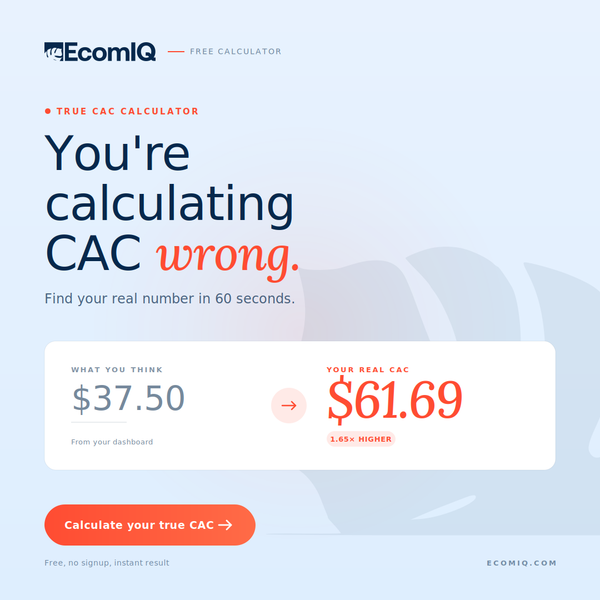
Most founders don't even know what their true CAC is. They look at ad spend divided by new customers and call it a day. That number is wrong, usually by 40-80%. Welcome discounts, free shipping, agency fees, creative production, all of that is acquisition cost. None of it shows up in your dashboard.
How to actually figure out your gap
I built a calculator for this exact reason. Plug in your CAC, your AOV, your margin, your repeat rate, and how many new customers you're acquiring per month. It tells you:
- Your real 12-month LTV (most founders can't calculate this off the top of their head, fair enough)
- How much cash you've got tied up in unrecouped CAC right now
- What a 10-point lift in repeat rate would free up
Five inputs. Sixty seconds. No signup. You'll see your number and probably wince a bit, that's normal.
What this means in practice
A few things to keep in mind once you've got your number.
If your tied-up cash is bigger than your bank balance, that's not a budget problem, it's a structural one. Means you're scaling acquisition faster than the business can recoup. Either slow down, raise capital, or fix one of the three levers above.
If your 12-month LTV:CAC ratio is below 2:1, you're running a treadmill. Below 1.5:1 you're losing money on every new customer. The cash gap will keep widening until you fix it.
If you're at 3:1 or better with healthy margins, your cash gap is normal, it's just the cost of growing. Plan inventory and hiring around the lag, don't try to outrun it.
The point isn't to feel bad about the number. The point is to know it. You can't fix what you can't see, and most founders are flying blind on this.
Run the calculator. Look at the number. Then figure out which of the three levers makes the most sense for your business right now.
That's it. No magic, no funnel hack, no growth secret. Just operators, not gurus, doing the work.