Increase Revenue Without Spending More on Ads
Sean Clarke
At League of Originals in LA this month (October 2026) I stood in front of a room of brand owners and asked a simple question. Who is spending on ads right now? Nearly every hand went up. Then I asked who had changed their site to lift conversion this year, and most hands stayed up. Then I pushed it one step further and asked them to keep their hand up only if they had actually tested each part of the store: the home page, the collection pages, the product page, the cart, the checkout and the page after purchase. The hands came down one page at a time. By the time I got to checkout, three were left.
That minute sums up what I see across almost every brand we work with. The effort goes into the ads, the creative, the targeting and the budget, and very little goes into what happens after someone clicks. It is the wrong way round. Most brands can increase revenue without spending a single extra dollar on ads, by earning more from the visitors they already pay for.
Why spending more on ads is the expensive way to grow
The pattern is nearly always the same. A brand tries new creative and things get a bit better. It tightens the targeting and things get a bit better again. It goes after new audiences, another small gain. Then the gains stop coming, and the only option left on the table is to spend more.
Spending more is not wrong. It is just expensive to do first, because every extra dollar lands on the same site that was already letting most visitors leave without buying. Your ads bring people in. Your site decides whether they buy. If the site is not doing its half of the job, more budget only buys you more people who leave.
The math of more revenue from the same traffic
Revenue on a Shopify store comes down to three numbers. Sessions, which is how many visits you get. Conversion rate, which is the share of those visits that turn into an order. And average order value, or AOV, which is what each order is worth. Sessions are what you buy with ads. The other two you can change without buying anything, and that is where the money is.
Let’s just run the numbers. Take an example store with 100,000 sessions a month, a 2% conversion rate and a $70 AOV. That is 2,000 orders and $140,000 in revenue. Now leave the traffic exactly where it is, lift conversion from 2% to 2.6% and lift AOV from $70 to $84. Revenue goes to $218,400. That is $78,400 more a month, from a 30% lift in conversion and a 20% lift in order value, on the same traffic.
Neither change is dramatic. The conversion lift on its own is worth $42,000. The AOV lift on its own is worth $28,000. Together they add another $8,400 on top, because every extra order also carries the higher order value. That compounding is the whole point. To be clear, this is an illustration, not a promise. Your numbers will be different, but the shape of the math holds for every store I have looked at.
It is not just theory either. Sweet E’s Bake Shop, one of our clients here in Los Angeles, went from a 0.9% conversion rate to 4.5%. Their repeat customer rate went up 41%, and they added around $30K a month in revenue. Same traffic.
Find the traffic earning you the least
Most brands look at one conversion rate for the whole store. Split that same example by where the traffic comes from and the picture changes. Paid social brings in 45,000 sessions, converts at 1.2% and earns $0.77 per visitor. Paid search earns $1.54. Organic earns $1.87. Email earns $2.51. Blended together, the store averages $1.40 per visitor and a 2% conversion rate, which looks fine on a dashboard.
Revenue per visitor is your conversion rate multiplied by your AOV. It is what each visit is actually worth to you. And in this example, the channel taking the most money earns the least per visitor. The blended number hides it completely.
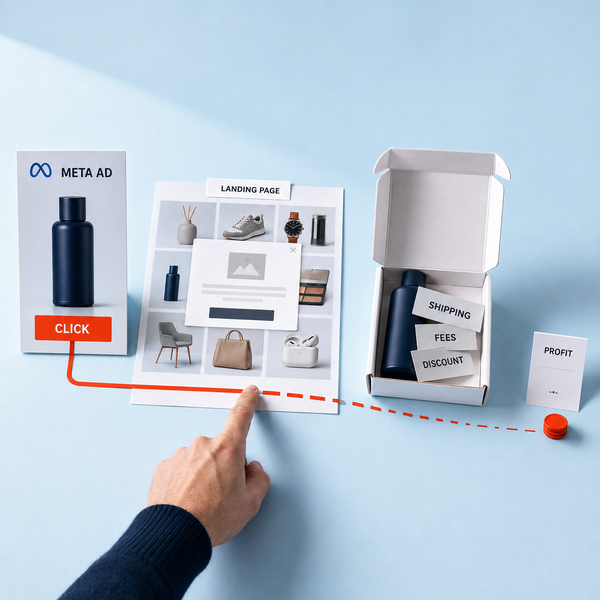
Frankly, that is usually a landing problem, not an ad problem. Cold traffic from Meta lands on a page built for people who already know the brand. Fix where that traffic lands, so the page carries on from what the ad said, and the same budget does more work.
Lever one: get more of your visitors to buy
ShopLift put it well on the day: traffic is rented, conversion is owned. Conversion rate optimisation, or CRO, means changing your store so a bigger share of visitors buy, and proving each change worked with a proper test rather than a hunch.
Start with the product page, because that is where people decide. Before anyone scrolls, a product page has five jobs. It says what the product is, says why it is for them, shows the price, shows proof like star ratings and a review count, and keeps the add to cart button within reach. Open your best seller on your phone tonight. Whichever of those five is missing is your first fix.
Then look at the cart. Show the full cost before checkout so there are no shipping surprises at the last step, put Shop Pay and Apple Pay right there, and add one line of trust under the button, like your returns policy or delivery time. ShopLift reports that Gym King came to them with slow page loads and years of apps piled on top of each other, and their testing program lifted conversion by 30% while the site got faster, not slower.
Lever two: make every order worth more
Once someone has decided to buy, the job is to help them find the next relevant thing. Not a random upsell, but the product that actually goes with what is already in their cart. There are four moments to offer it: on the product page, in the cart, in checkout, and on the page after purchase.
A free shipping threshold does a lot of the work here. Set it a little above what most people already spend, around 15% to 30% above your current AOV, and show the gap in the cart. A line that says you are $12 away from free shipping does the selling, and a small add-on product closes it. Set the threshold below your AOV and you are paying to ship orders you would have got anyway, while pulling nobody up.
Reviews matter just as much, because they answer the doubt that stops someone adding one more item. In Okendo’s Dr. Squatch customer story, shoppers who interacted with reviews converted 79% better and spent 16% more per order than shoppers who did not. Treat those as Okendo’s numbers for that brand, not a forecast for yours, but the direction is clear.
Lever three: get customers coming back
The cheapest order you will ever get is the second one from a customer you already have. You only pay to win them once. Every time they come back, there is no ad cost at all.
In our example, the improved store is winning 2,600 customers a month. If one in four of them buys again, that is another 650 orders. At $84 each, that is another $54,600 in revenue, without a single extra dollar going into ads.
Lifetime value, or LTV, is what a customer is worth across every order they ever place, and it is where email and loyalty earn their keep. Build your welcome, abandoned checkout and post-purchase flows before you add more campaigns, because those automated emails do a disproportionate share of the work for the effort they take. Loyalty works the same way. Okendo reports that NOBULL’s loyalty members bought again at more than twice the rate of non-members and spent 9% more per order.
The bonus: your ad return improves too
Pull those three levers and something else happens that most founders don’t expect. Your return on ad spend goes up without you changing a single ad. Blended ROAS is your total store revenue divided by your total ad spend, sometimes called MER, or marketing efficiency ratio. It is what the whole store makes for every dollar you put into ads.
In our example, ad spend stays at $35,000 a month the whole way through. Before the changes, blended ROAS is 4.0x and each new customer costs $17.50. After lifting conversion and order value, blended ROAS is 6.2x and each customer costs $13.46, because more of the people you paid for actually bought. Add the repeat orders from lever three and blended ROAS climbs to 7.8x. Same ads, same budget, a much better return.
One note on revenue versus profit, because they are different problems. Everything above is revenue. Profit depends on your margins, your discounts and your shipping costs, so run every change through your contribution margin as well, which is what is left of each order after product cost, shipping, payment fees and discounts. A change that lifts revenue and wrecks your margin is not a win.
How to increase revenue without spending more on ads
Crawl, walk, run.
Crawl. Pull four numbers from Shopify for the last 30 days: sessions, orders, conversion rate and AOV. Multiply conversion rate by AOV to get your revenue per visitor, then do the same for each traffic source. You will know by tonight which channel is earning the least per visitor.
Walk. Fix one thing. Pick the biggest gap on your best-selling product page, or build one dedicated landing page for your top-spending paid social campaign, and test it properly. One change, at least two full weeks, judged on revenue per visitor and margin.
Run. Once conversion is moving, turn to order value and repeat customers. Set your free shipping threshold, add the right offer at the four moments, and get your core email flows, reviews and loyalty working. Only then go back to the ad budget.
That is the order I would work in, and it is the order we work in with our own clients. Conversion rate first, then order value, then lifetime value. Each one grows revenue on the traffic you already have, and none of them needs a bigger ad budget.
Only once all three are working is it time to spend more, because every extra dollar then lands on a site that converts better, sells more per order and keeps customers longer. We coach on Monday what we tested on Friday, because my agency is running these tests every week with real budgets and real brands. At the end of the day, the fastest way to grow revenue is usually not more ads. It is getting more from the ones you are already paying for.